Advancing Head Protection in the Building and Construction Industry
A framework for aligning national and international industrial helmet standards
Contents
-
Head protection in construction is changing
-
Why head protection needs to evolve
-
From hard hats to enhanced helmets
-
What are the AS/NZS 1801:2024 changes
-
What are the BS EN 397:2025 Type 2 changes
-
Where EN 12492 hybrid helmets fit
-
Why retention systems matter
-
Why off-crown impact protection matters
-
Interconnecting PPE
-
What this means for New Zealand construction
-
The case for helmet standardisation
Date Prepared: 27 June 2025
Version: 1.0
Prepared by: Anthony Ford, ZERO Height Safety (NZ/AU) Limited
Head protection in construction is changing
For many years, the traditional hard hat has been the accepted symbol of safety on site. It has played an important role in protecting workers from falling objects and crown impacts, and it remains a recognised form of head protection in many working environments.
But modern worksites are no longer static. Workers move between tasks, machinery, uneven ground, elevated platforms, confined spaces and changing site conditions throughout the day. The risks are more dynamic, and head protection needs to reflect that.
Slips, trips, low-height falls, side impacts, rear impacts and loss of helmet retention are now part of the real-world risk profile across construction, infrastructure, utilities and other high-risk sectors. These hazards do not only affect people working at height. They affect workers across the site.
The introduction of AS/NZS 1801:2024 and BS EN 397:2025 marks an important step forward. Both standards recognise the need to move beyond crown-only impact protection and toward helmets tested for more realistic impact scenarios.
This page provides a practical overview of what is changing, why it matters, and how New Zealand can take a more consistent approach to head protection across the construction industry.
Why head protection needs to evolve
The nature of risk on construction sites has changed. Traditional hard hats were primarily designed to protect against objects falling from above. That remains an important hazard, but it is not the only one. Workers are also exposed to lateral impacts, slips, trips, falls from standing height, low-height falls, moving plant, scaffolding, temporary works and fast-changing site environments.
In these situations, the direction of impact is often unpredictable. A worker may strike the front, side or rear of the helmet during a fall or collision. If the helmet does not remain securely fitted, it may not provide protection when it is needed most. This is where enhanced helmets, multi-impact helmets and secure retention systems become important.
The shift is not simply about replacing one helmet style with another. It is about aligning helmet selection with the actual risks workers face. A helmet that only considers vertical impact may not provide a complete response to modern construction risk.
As New Zealand continues to improve health and safety performance, head protection should be viewed as part of a broader safety strategy, not just a compliance item.
From hard hats to enhanced helmets
The language around head protection is also changing. Terms like hard hat, climbing-style helmet and work-at-height helmet have been widely used in the market, but they are not always precise. The latest standards provide a clearer way to describe helmet performance.
Type 1 helmets are general occupational helmets. They are mainly designed for vertical crown impact protection, usually from falling objects. These are the helmets most people would traditionally describe as hard hats.
Enhanced helmets, including AS/NZS 1801:2024 Type 4 and BS EN 397:2025 Type 2 helmets, are designed to provide protection across a wider range of impact points. This includes crown, front, side and rear impact zones, along with improved retention performance.
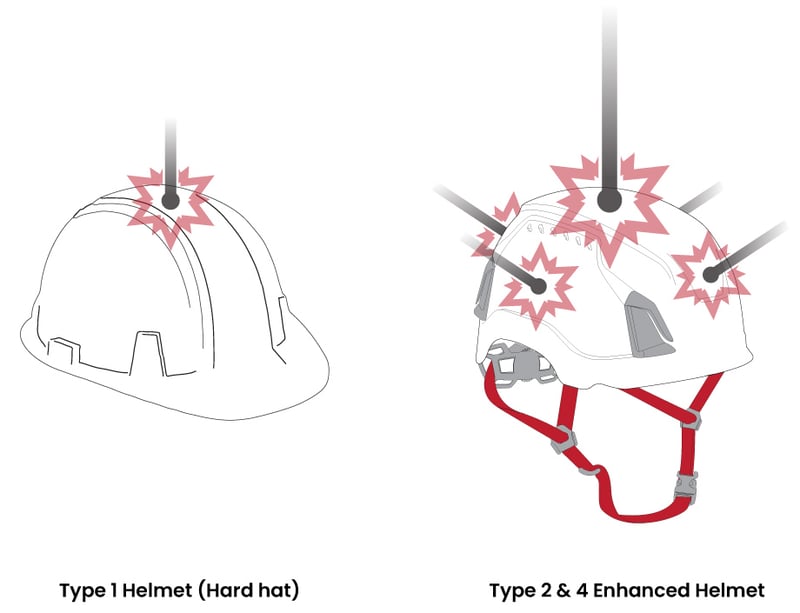
In practical terms, the difference is simple;
-
A Type 1 helmet is primarily about protection from above.
-
An enhanced helmet is about protection in more dynamic environments where the direction of impact may not be predictable.
This distinction matters because many workers move through multiple risk zones during the same day. A site-wide approach to enhanced helmets can reduce confusion, simplify procurement and help ensure workers are protected against a broader range of hazards.
What are the AS/NZS 1801:2024 changes
AS/NZS 1801:2024 introduces a new and important classification for enhanced occupational protective helmets.
Type 4 helmets are designed for environments where workers may be exposed to both falling objects and impacts associated with falls from standing or low heights. This provides a local standard pathway for helmets that offer multi-directional impact protection.
The key change is the formal recognition that occupational helmets may need to protect against more than crown impacts.
Type 4 helmets are tested for impact energy attenuation at multiple locations, including off-centre impact zones. They also include requirements for retention strength and helmet stability, which are critical when a worker slips, trips, falls or moves suddenly.
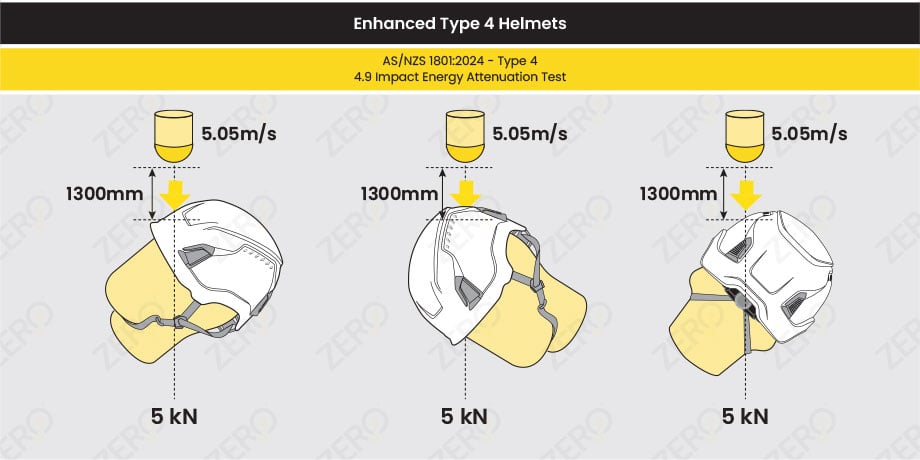
For many years, the local market relied heavily on older helmet classifications that did not fully reflect the way modern worksites operate. AS/NZS 1801:2024 helps close that gap by creating a defined category for enhanced head protection.
However, the standard also presents challenges. The technical requirements for Type 4 helmets are demanding, and international availability may take time. Until more Type 4 helmets are commercially available, New Zealand businesses may need to consider other recognised pathways that deliver similar safety outcomes.
What are the BS EN 397:2025 Type 2 changes
BS EN 397:2025 also introduces a significant update to industrial head protection.
The revised standard creates a two-tier structure. Type 1 helmets continue to address traditional crown impact protection, while Type 2 helmets introduce additional testing for off-crown impacts and retention system performance. This is an important international shift.
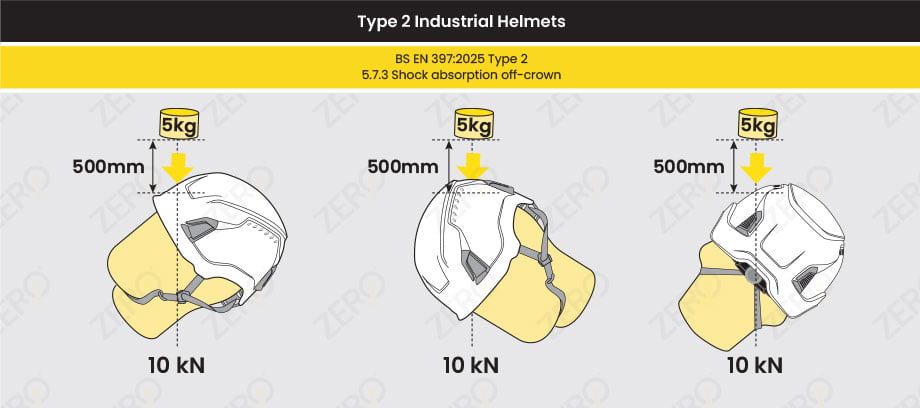
BS EN 397:2025 Type 2 recognises that industrial helmets need to perform in situations where impacts may occur to the front, side or rear of the helmet. It also supports stronger retention requirements, helping to ensure the helmet remains in place during movement, impact or a fall.
For New Zealand, BS EN 397:2025 Type 2 may provide a practical and scalable pathway. Many global manufacturers are already familiar with EN standards, and many existing helmet designs have evolved from EN 12492 or hybrid EN 397 models.
This means Type 2 helmets are likely to become increasingly available across international PPE supply chains.
While AS/NZS 1801:2024 Type 4 and BS EN 397:2025 Type 2 are not identical, they are moving in the same direction. Both recognise that modern head protection needs to address off-crown impact and secure helmet retention.
Where EN 12492 hybrid helmets fit
Before the latest industrial helmet standards were introduced, many New Zealand worksites had already moved toward higher-performing helmets.
In the absence of a local multi-impact industrial standard, many organisations adopted helmets certified to EN 12492, the European mountaineering helmet standard. These helmets were originally developed for climbing and mountaineering, but they offered features that were highly relevant to construction and infrastructure worksites. These features included secure chinstraps, close fit, reduced helmet loss during movement and improved protection against impacts from multiple directions.
To better suit industrial applications, some helmets were also tested to parts of EN 397, creating what the market often described as hybrid helmets. These helmets helped bridge the gap between traditional hard hats and the performance needs of modern worksites. As BS EN 397:2025 Type 2 becomes more established, many of these hybrid models are likely to transition toward updated industrial certification.
In the meantime, EN 12492 and hybrid-certified helmets have played an important role in lifting the standard of head protection across New Zealand. They should be understood as part of the industry’s transition toward enhanced occupational helmets.
Why retention systems matter
A helmet can only protect the worker if it stays on the head.
This is one of the most important changes in the way the industry thinks about head protection. Impact performance matters, but retention performance is just as critical in dynamic work environments.
Traditional hard hats often have limited retention capability. In many cases, chinstraps are optional or designed to release under relatively low loads. That may be suitable in environments where entanglement is the greater risk, but it may not be suitable where a worker is at risk of falling, slipping or striking their head from the side or rear. Enhanced helmets place greater emphasis on keeping the helmet securely positioned during movement and impact.
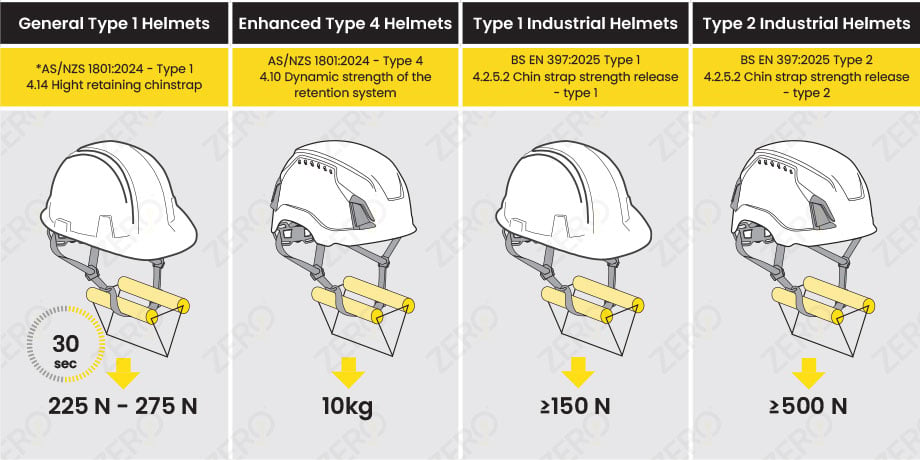
This matters on construction sites because workers are rarely still. They climb, bend, reach, carry materials, enter confined spaces, work around plant and move across uneven surfaces. If a helmet shifts or comes off during a fall, its protective value is reduced at the exact moment it is needed.
A secure, well-fitted helmet with an appropriate retention system helps close that gap.
Why off-crown impact protection matters
Real-world impacts do not always come from above.
A worker who slips on uneven ground may strike the side or rear of their head. A worker moving around scaffolding or machinery may impact the front or side of their helmet. A fall from a low height can involve rotation, movement and unpredictable contact points.
This is why off-crown impact testing is important. Enhanced helmet standards recognise that protection should not be limited to the top of the helmet. Testing across front, side and rear zones provides a better indication of how a helmet may perform in realistic worksite conditions. This is one of the clearest differences between traditional hard hats and enhanced helmets.
Hard hats remain focused mainly on falling object protection. Enhanced helmets are designed to address a broader range of impact scenarios.
For contractors, safety managers and procurement teams, this creates an opportunity to reassess helmet policies. The question should not only be whether a helmet meets a minimum standard. The better question is whether it is suitable for the actual risk environment workers are exposed to.
Interconnecting PPE
Modern worksites expose workers to more than impact risk.
Sun exposure, dust, flying particles, noise, glare and airborne hazards are common across construction and infrastructure environments. As a result, helmets increasingly need to support connected protection, including visors, face shields, earmuffs, sun brims, neck protectors and lamp attachments. This makes accessory compatibility an important part of helmet selection.
Both AS/NZS 1801:2024 and BS EN 397:2025 allow for the use of accessories where they do not compromise the certified performance of the helmet. The key point is that accessories should be approved by the manufacturer and fitted correctly. This is important because untested or incompatible accessories may affect helmet fit, retention, impact performance or marking visibility.
As worksites become more complex, a helmet should be viewed as part of a system. The shell, liner, retention system and accessories need to work together to provide reliable protection.
For many workers, the helmet is no longer a standalone item. It is the platform for eye, face, hearing and sun protection.
What this means for New Zealand construction
New Zealand has an opportunity to take a more consistent approach to head protection.
The industry has already shown leadership by adopting higher-performing helmets ahead of formal regulatory change. Many construction, utilities, infrastructure and forestry organisations have recognised that traditional hard hats do not always reflect the risks their workers face.
The introduction of AS/NZS 1801:2024 Type 4 and BS EN 397:2025 Type 2 provides a clearer framework for the next stage of that transition. Recognising both standards in parallel may be a practical way forward.
AS/NZS 1801:2024 Type 4 provides a local pathway for enhanced occupational helmets. BS EN 397:2025 Type 2 provides an internationally recognised pathway that may be more readily available through global supply chains.
Both standards support the same broad safety direction: improved protection against multi-directional impacts and stronger helmet retention. For New Zealand businesses, the focus should be on safety outcomes. A suitable helmet policy should consider the nature of the work, the likelihood of off-crown impacts, the need for secure retention, accessory requirements, user comfort and long-term availability.
The case for helmet standardisation
Managing different helmet types across a site can create unnecessary complexity.
If one group of workers is required to wear enhanced helmets while another group wears traditional hard hats, the result can be confusion around site rules, training, compliance and procurement. It can also create grey areas where workers move between tasks or risk zones. A standardised approach can make helmet policy easier to understand and enforce.
For many construction sites, a universal move toward enhanced helmets may provide a simpler and more practical solution. Workers often move between hazards throughout the day, and the difference between a low-risk and high-risk area is not always clear. Using a single enhanced helmet platform across a site can help improve consistency. It can also support clearer induction processes, simpler audits and better alignment between contractors, subcontractors and site managers.
The goal is not to overcomplicate PPE selection. It is to make head protection more relevant to the way construction work actually happens.
The ongoing transition toward enhanced head protection across New Zealand construction and infrastructure does not mean every traditional hard hat immediately becomes unsuitable. Type 1 helmets remain recognised and may still be appropriate in static, crown-impact environments. However, modern construction sites are increasingly dynamic. Workers face multiple hazards from multiple directions, and helmet selection should reflect that reality.
The future of industrial head protection will be built around three core principles:
-
Helmets should provide protection against multi-directional impact.
-
Helmets should remain securely fitted during movement, slips, trips and falls.
-
Helmets should support integrated eye, face, hearing and sun protection without compromising performance.
The release of AS/NZS 1801:2024 and BS EN 397:2025 is an opportunity to align product selection, procurement and site policy with the real risks workers face.
New Zealand has the opportunity to lead with a practical, evidence-based approach to head protection. That means recognising suitable local and international standards, supporting a clear transition pathway and raising expectations for what good head protection should deliver.
For a deeper technical overview, including detailed standard comparisons, testing summaries, diagrams, references and discussion of AS/NZS 1801:2024, BS EN 397:2025 and EN 12492 hybrid helmets, download the full ZERO white paper.