
Slips, Trips and Falls in Residential Construction
Recognising critical risk and the role of enhanced head protection
Contents
-
Who should read this whitepaper?
-
Introduction
-
Why this paper matters
-
The impact of falls and workplace injuries in New Zealand
-
Managing head trauma from slips, trips & falls
-
Choosing head protection that matches the risk
-
A continued shift towards enhanced head protection
-
Enhanced head protection as a PPE platform
-
Further reading
Date Prepared: 1 July 2026
Version: 1.0
Prepared by: Anthony Ford, ZERO Height Safety (NZ/AU) Limited
Who should read this whitepaper?
This whitepaper has been written for small residential building companies, contractors, business owners, site supervisors and health and safety advisers. It is intended to support practical decision-making, particularly for businesses that need clear guidance without unnecessary complexity.
The aim is not to suggest that every slip, trip or fall requires the same response. The aim is to help residential builders recognise when a common site hazard could become a critical risk, and when enhanced head protection should be considered as part of the control measures.
Introduction
Residential construction is a dynamic work environment. Site conditions change as the build progresses, and the way workers move through the site changes with it. What may appear to be a routine slip, trip or fall hazard at one stage of the build can become a critical risk at another.
Slips, trips and falls are often managed through housekeeping, clear access and general site tidiness. These are important controls and should remain part of good site practice. However, they do not always address the full risk. On a residential building site, a slip, trip or fall can become a critical risk and lead to serious head injury, including traumatic brain injury or loss of consciousness.
The key issue is not simply whether a slip, trip or fall could occur. The key issue is what the consequence could be if it does occur. A risk that is usually treated as low level can become critical when the surrounding site conditions increase the likelihood of head impact, fall from height or another serious outcome.
This is particularly important for small residential building companies. These businesses often operate with smaller teams, multiple subcontractors and site conditions that change quickly. Health and safety decisions still need to be practical, but they also need to be strong enough to manage critical risks effectively.
For this reason, slips, trips and falls should not be classified by the hazard label alone. They should be considered through the normal process of identifying and assessing risks, then selecting control measures that are proportionate to the potential consequence.
This paper focuses on the role of enhanced head protection where a head-impact risk remains foreseeable. It does not suggest that PPE replaces higher-order controls or good site management. These controls remain essential.
However, where a slip, trip or fall could credibly result in serious head injury, head protection should be considered as part of the control measures. In those situations, enhanced multi-impact tested helmets can provide a practical way to reduce the consequence of head impact and support better protection for workers in residential construction.
Why this paper matters
Slips, trips and falls are often managed through housekeeping, clear access and general site tidiness. These remain important controls and should be part of good site practice. However, they do not always address the full risk.
On a residential building site, a slip, trip or fall can become a critical risk where the consequence could include serious head injury, traumatic brain injury or loss of consciousness. This is particularly important for small residential building companies, where teams are often smaller, work conditions change quickly, and decisions need to be practical without reducing the level of protection provided to workers.
The critical risk question
The key issue is not only whether a slip, trip or fall could occur. The key issue is what the consequence could be if it does occur.
A hazard that is usually treated as low level can become critical when the surrounding site conditions increase the likelihood of head impact, fall from height or another serious outcome. For this reason, slips, trips and falls should not be classified by the hazard label alone. They should be considered through the normal process of identifying and assessing risks, then selecting control measures that are proportionate to the potential consequence.
The impact of falls and workplace injuries in New Zealand
Falls place a significant burden on New Zealand workers, businesses, families and the wider injury system. Fall-related active claim costs increased from $1.11 billion in 2017 to $2.58 billion in 2025.
ACC recorded 26,941 new work-related claims in the construction sector alone in 2025. ACC also notes that construction injuries resulted in over 1 million days of weekly compensation. These figures show why slips, trips and falls need to be taken seriously when identifying and assessing risks in residential construction.
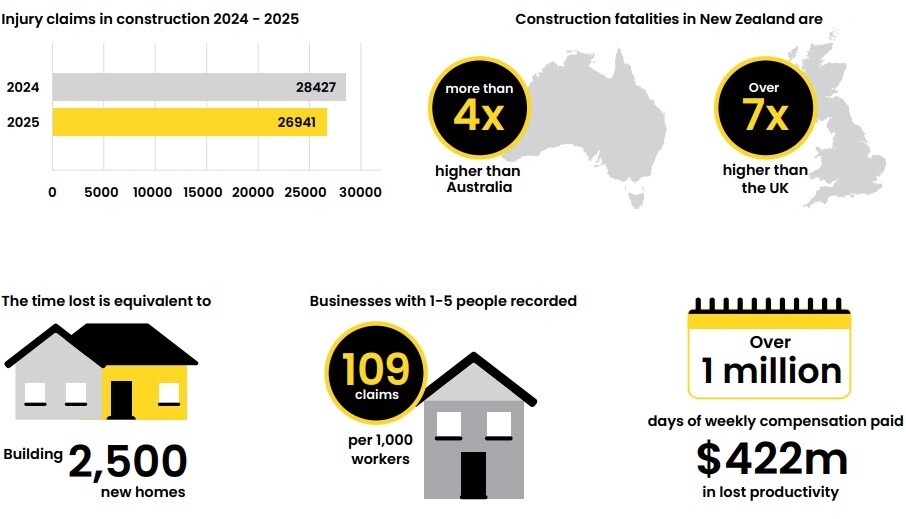
Work-related injuries commonly occur in higher-risk industries, including construction, where workers are exposed to risks such as machinery, vehicles, manual handling and working at height. ACC recorded 26,941 new work-related claims in the construction sector alone in 2025.
In its 2025 injury report, ACC notes that construction injuries resulted in over 1 million days of weekly compensation. It also identifies strains and sprains, slips, trips and falls, and vehicle-related incidents as leading causes of workplace injury.
The impact is not only financial. Injuries affect how people work, recover, support their families and return to normal life. Time away from work can make recovery harder, reduce workforce capacity and place pressure on businesses, projects and teams.
Source: ACC - Work injury statistics 2024/2025, ACC - Injuries in New Zealand report 2025
Managing head trauma from slips, trips & falls
PPE is the last control in the hierarchy of controls, so it must be fit for purpose and matched to the risk. This is particularly important where a slip, trip or fall could result in serious harm or meet the threshold of a notifiable event.
A slip, trip or fall is not automatically a notifiable event. However, WorkSafe’s notifiable injury guidance highlights why the potential consequence must be considered. Serious head injuries requiring immediate treatment can include loss of consciousness, bleeding or a blood clot in the brain, skull damage affecting organ or facial function, or temporary or permanent memory loss.
For this reason, slips, trips and falls should not be treated as low risk by default. A proper risk assessment should consider how the event could occur, who could be harmed, and how serious the outcome could be. Where serious head injury is a foreseeable consequence, the selected control measures should reflect that level of risk.
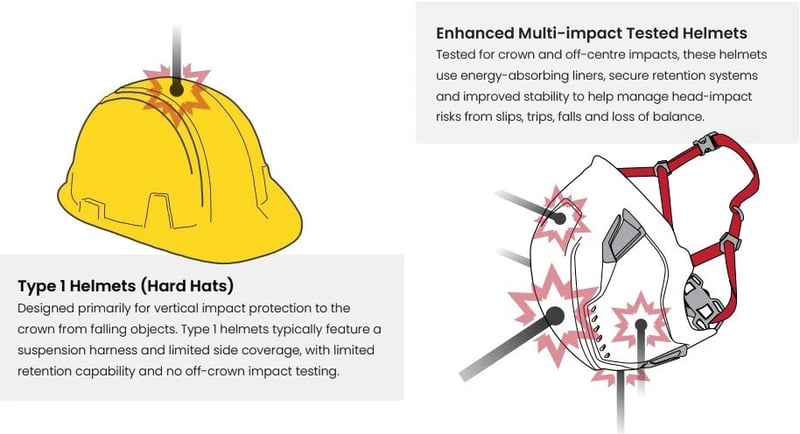
Traditional industrial hard hats have played a long-standing role on worksites, particularly where the primary risk is vertical impact from falling objects. However, they are not designed around the same impact scenarios that can occur when a worker slips, trips, falls from ground level or height, or loses balance.
Where the assessment identifies a foreseeable off-crown head-impact risk, or a risk of falling from height, a multi-impact tested helmet may be a suitable PPE control measure. These helmets are designed for more demanding impact scenarios and are intended to remain securely fitted to the head during a fall.
Choosing head protection that matches the risk
Choosing head protection should not be reduced to whether a helmet meets a standard or what the purchase price is. The better starting point is to identify the risk, assess the possible outcome, and select protection that matches how the worker could actually be injured.
A traditional hard hat may be suitable where the main risk is falling objects striking the crown of the head. Where the risk includes slips, trips, falls, loss of balance, lateral impact or off-crown impact, enhanced multi-impact tested head protection may be a more suitable control measure.
The following are five common mistakes to avoid:
1. Choosing head protection without identifying the risks
Slips, trips and falls are often treated as routine site hazards, with housekeeping used as the tick-box control. On construction sites, a slip, trip or fall can become a critical risk. A head impact from that event can result in traumatic brain injury, so the control measures need to match the possible outcome, not just the hazard label.
2. Assuming a hard hat will protect you in a fall
Traditional hard hats (often referred to as Type 1 helmets) are designed and tested to protect from dropped objects striking the top of the crown only. Slips, trips and falls create a different type of risk. Head impacts can occur to the front, side or rear of the head, not only the crown so other control measures should be considered.
3. Treating the helmet as a single control measure
Modern head protection can do more than absorb impact. A fully integrated helmet system can act as a PPE hub, allowing compatible eye, face and hearing protection to connect quickly and securely. That matters on dynamic and changing sites where workers move between framing, cutting, drilling, grinding, noisy work and outdoor conditions.
4. Overlooking fit, comfort and correct use
Comfort affects compliance. If a helmet is uncomfortable, unstable, poorly balanced or hard to adjust, workers are less likely to engage with it or wear it correctly. A helmet needs to fit the team, not just meet a standard. If workers wear it correctly, protection improves.
5. Letting price outweigh function
The cheapest helmet is not always the lowest-cost option. Value comes from head protection that matches the risk, fits the worker and makes the right PPE easier to use. In some applications, integrated technology can also support lone worker safety through alerts, location sharing or faster assistance after an event.
In today’s dynamic work environments, head-impact risks are not limited to vertical impacts from falling objects. Lateral and rearward impacts, along with slips, trips, and falls from standing height or low elevation, can be present across many roles. In response, many organisations have adopted multi-impact tested helmets that more accurately reflect the realities of modern worksites.
A continued shift towards enhanced head protection
The commercial construction and infrastructure sectors have already started the shift towards enhanced multi-impact tested head protection to provide better worker protection from lateral impacts.
Traditional hard hats were designed around a familiar risk: falling objects striking the crown of the head. That risk still exists, but modern worksites involve more than vertical impact. Head impacts can occur from multiple directions, particularly where a worker slips, trips, falls or loses balance.
This is why many organisations have moved towards enhanced helmets with multi-impact testing, improved retention, better stability and compatibility with other PPE. The shift is not only about meeting a newer standard. It is about selecting protection that better matches how workers may actually be injured.
Residential construction faces many of the same risks, but often with less formal site control. That makes practical helmet selection even more important. For small builders, the issue is not whether they should copy every requirement used on major commercial projects. The issue is whether their own workers face credible head impact risks that are not adequately addressed by traditional crown-impact protection.
A residential building company does not need to add unnecessary complexity to improve head protection decisions. The starting point is to identify and assess the risk in the conditions workers are actually facing. If the likely outcome is a minor injury, normal site controls may be enough. If the foreseeable outcome includes head impact, a fall from height, loss of consciousness or another serious harm event, stronger control measures are required.
Where a slip, trip or fall risk remains after other controls have been applied, the selected head protection should match the risk. If the credible outcome includes lateral or off-crown head impact, a multi-impact tested helmet may provide a practical and proportionate way to reduce the risk of traumatic brain injury.
Where enhanced head protection is selected, the business should also set clear expectations. Workers should know when helmets are required, how the chinstrap is to be worn, how accessories are fitted, when the helmet must be replaced, how damage is reported, and how the helmet integrates with eye, face and hearing protection.
Enhanced head protection as a PPE platform
Modern head protection can also support better use of other PPE. Residential builders and trades may face eye, face, hearing and sun exposure risks during everyday site activity.
For many small businesses, PPE use can be affected by convenience. If eye, face, hearing and sun protection becomes too cumbersome to apply, workers may delay use or use the wrong item or work without the right protection. An enhanced helmet that functions as an integrated PPE platform can help reduce that friction.
Modern helmets often have the ability to attach compatible eye protection, face protection, hearing protection, sun protection and other accessories. This can improve practical compliance because the right PPE is easier to access, easier to fit and more likely to be used when the task changes. This matters on residential sites because work changes quickly and PPE requirements change with it.
Digital safety features may also have a role in some applications. Technology that supports identification, emergency information, lone worker alerts, immobility alerts or location sharing may help improve response when a worker is isolated or when an event is not immediately witnessed. These features should not be treated as a substitute for supervision, planning or emergency procedures, but they may add value where the work context supports their use.
When selecting head protection, businesses should consider more than impact performance alone. The helmet should suit the tasks, the work environment and the supporting PPE required to achieve safer and more practical outcomes.
Comfort, fit and worker acceptance
A helmet only protects a worker if it is worn correctly. Comfort and fit are practical safety issues. If a helmet is uncomfortable, unstable, hot, poorly balanced, difficult to adjust or incompatible with other PPE, workers are less likely to wear it properly. They may loosen the harness, remove the chinstrap, wear it backwards, take it off between tasks or leave it in the vehicle.
This is particularly relevant for small residential builders because site culture is often set by a small number of people. If the owner, foreman or lead carpenter treats head protection as optional, the rest of the team is likely to follow. If the business selects protection that workers accept and wear properly, compliance becomes easier.
The right head protection decision should consider the users, the tasks and the conditions. A helmet should fit the team, remain stable during movement, work with other PPE, suit the climate, allow practical adjustment and be supported by clear expectations on when and how it is worn.
References
New Zealand Standards, AS/NZS 1801:2024 - Occupational Protective Helmets: Type 1.
https://www.standards.govt.nz/shop/asnzs-18012024
New Zealand Standards, AS/NZS 1801:2024 - Occupational Protective Helmets: Type 4.
https://www.standards.govt.nz/shop/asnzs-18012024
The British Standards Institution, BS EN 397:2025 - Industrial safety helmets.
https://knowledge.bsigroup.com/products/industrial-protective-helmets-1
The British Standards Institution, BS EN 12492:2012 - Mountaineering equipment. Helmets for mountaineers. Safety requirements and test methods.
https://knowledge.bsigroup.com/products/mountaineering-equipment-helmets-for-mountaineerssafety-
requirements-and-test-methods?version=standard
The British Standards Institution, BS EN 397:2012+A1:2012 - Industrial safety helmets.
https://knowledge.bsigroup.com/products/industrial-safety-helmets?version=standard
WorkSafe NZ, New draft code of practice for residential construction.
https://www.worksafe.govt.nz/topic-and-industry/construction/new-acop-residential-construction/
WorkSafe NZ, WKS 5 - What events need to be notified
https://www.worksafe.govt.nz/notifications/what-events-need-to-be-notified/
Accident Compensation Corporation (ACC), Work injury statistics
https://www.acc.co.nz/newsroom/media-resources/work-injury-statistics/
Accident Compensation Corporation (ACC), Injuries in New Zealand report.
https://www.acc.co.nz/assets/corporate-documents/Injuries-in-New-Zealand-2025.pdf
ZERO Height Safety, Advancing Head Protection in the Building and Construction Industry.
https://zeroheightsafety.com/advancing-head-protection-in-the-building-and-construction-industry
Further reading
For a technical overview of industrial helmet standards and enhanced head protection, including AS/NZS 1801:2024, BS EN 397:2025, EN 12492, retention systems and off-crown impact protection, refer to ZERO’s whitepaper.
 Advancing Head Protection in the Building and Construction Industry